
My first contact with naval hydrodynamics CFD applications started around 2006. With a wealth of experience in free surface flows and 2 generations of numerics improvements I implemented in interFoam, I felt no surprises are coming. Ultimately, “a free surface flow is a free surface flow”; it is not easy but it cannot be radically different from what I have done so far.
A wake-up call came from a CFD consulting company with extensive America’s Cup experience contacting Wikki around 2009 for some benchmark work. His first statement was: “Nice code. Regrettably, it is a thousand times to slow!”.
I was stunned. How can a CFD code be 1000 times slower than competition, when it is build on sound and validated basis of OpenFOAM discretisation, linear solvers and parallelisation I have so carefully developed? I would have taken 20% slower, but a thousand-fold? There must be something special here.
The client worked around the problem by buying a dozen entry level workstations and running in parallel. It still turned out cheaper than paying commercial parallel CFD licences. In any case, the difference was not a factor of 1000, but the story was true. This is my starting point.
What is so special about naval hydrodynamics CFD. First, one needs to recognise many different types of simulations. I will just give a brief overview.
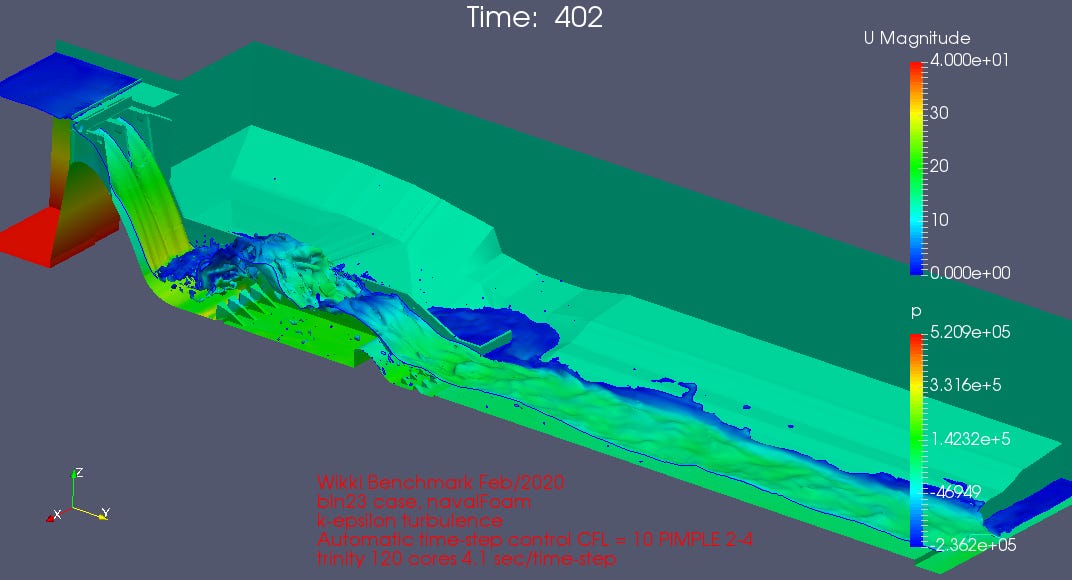
Free surface channel flows are a good precursor case. The geometry is fixed, the flow looks steady but the free surface will move in a flow-normal direction, turbulence matters. The biggest problem is flow-through time: for a particle travelling at 2 m/s traversing a 200-meter channel, it will take 100 seconds to traverse the domain. And this number does not care about how big your mesh is. Lesson 1: a transient problem that looks like steady-state. Very large Courant number; very long simulation time.
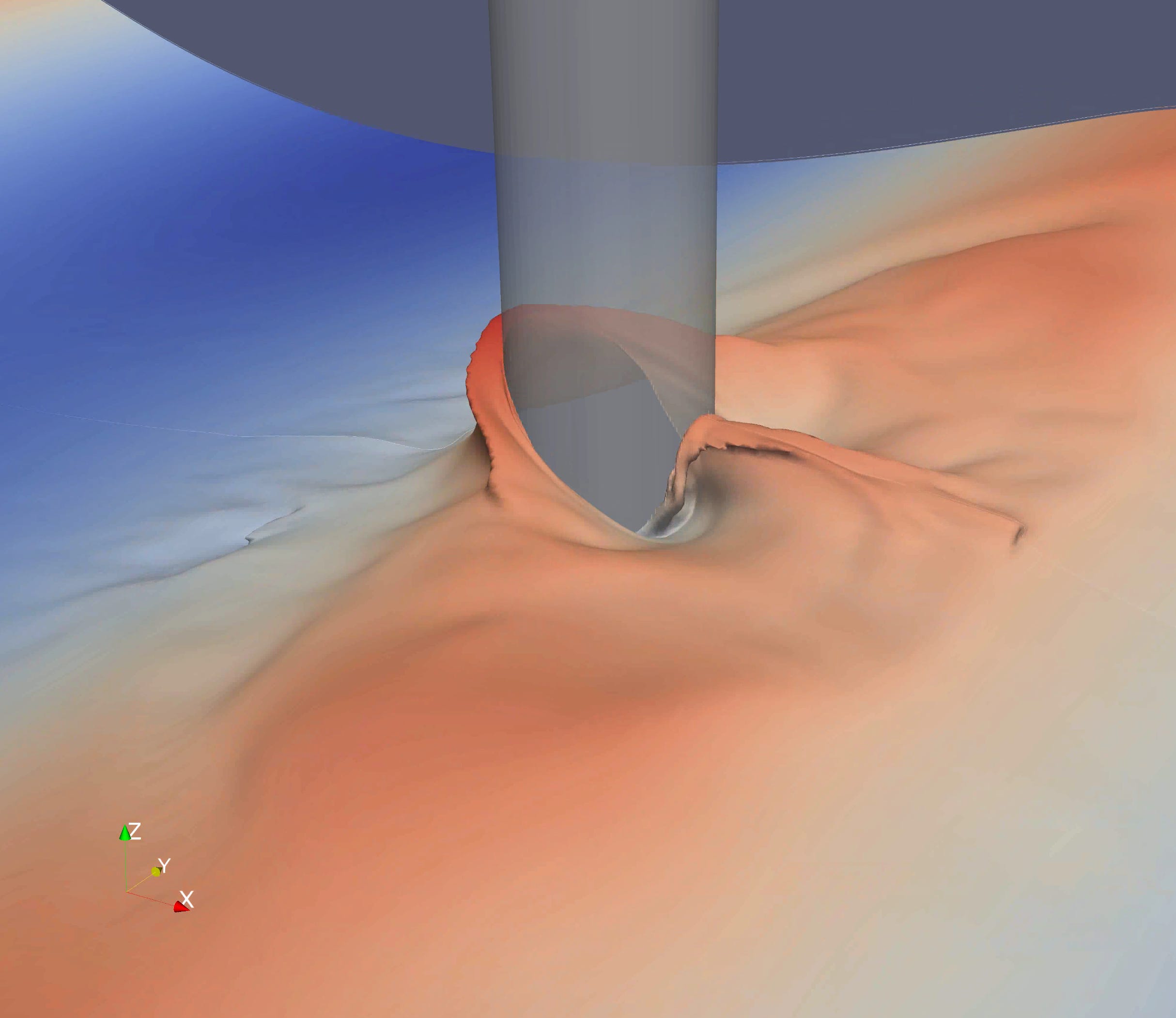
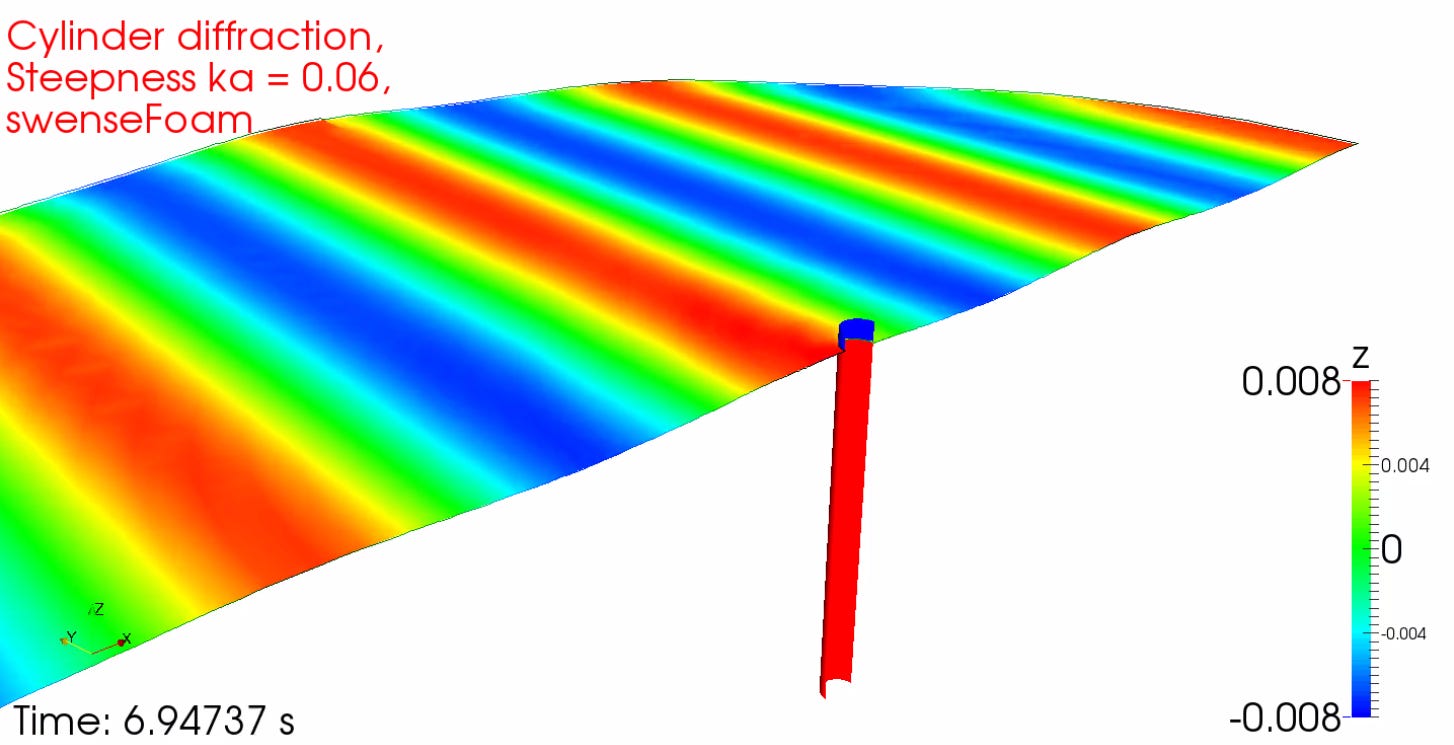
Lesson 1: forces on static structure. Here, we are looking for flow-induced forces on a static object, such a a pylon or a column. Even for steady incoming flow, the free surface is likely to give complex shape of free surface, which may be unsteady. Getting such forces right is an absolute must: if forces are not predicted accurately, all further developments are meaningless.
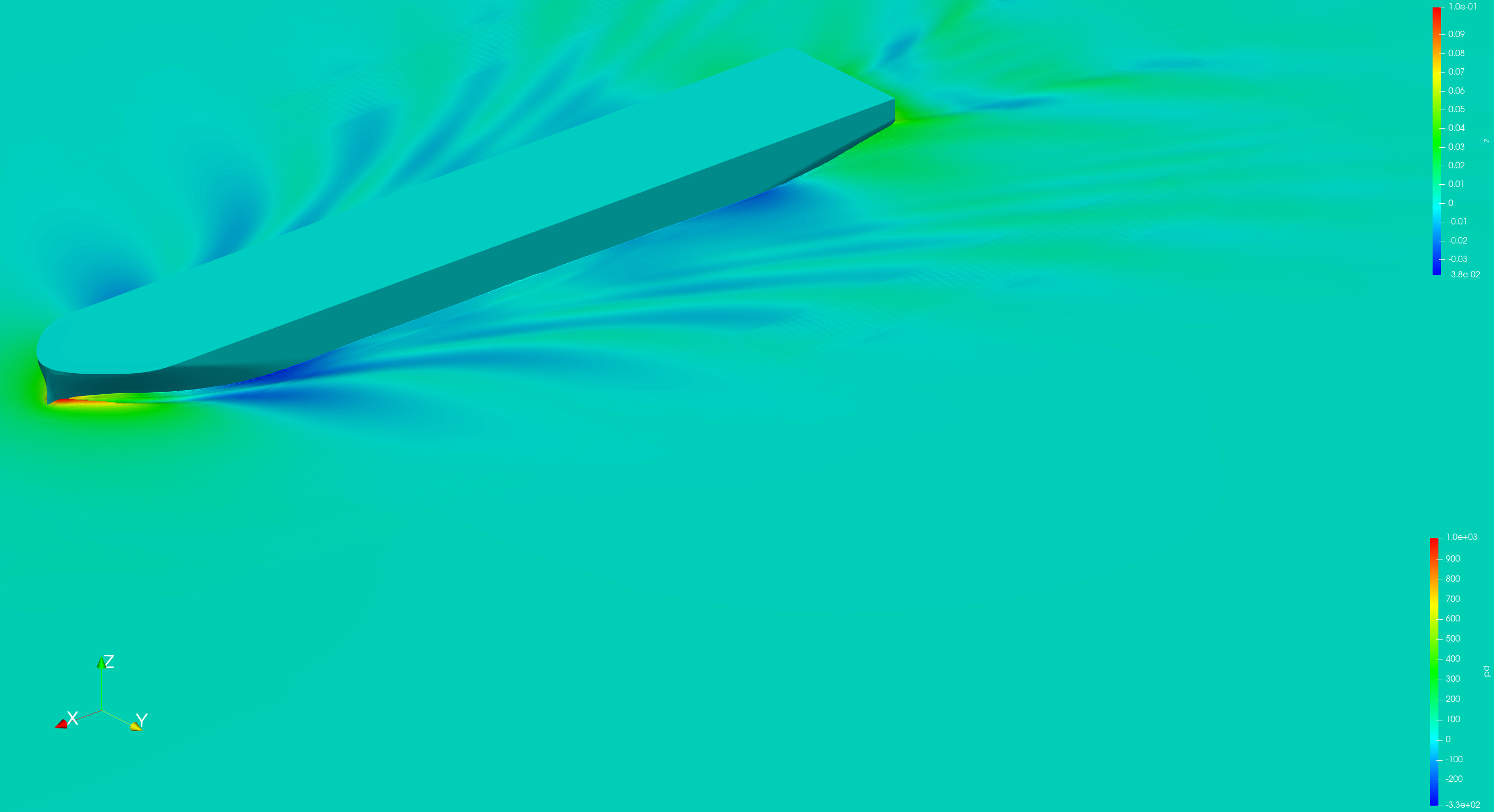
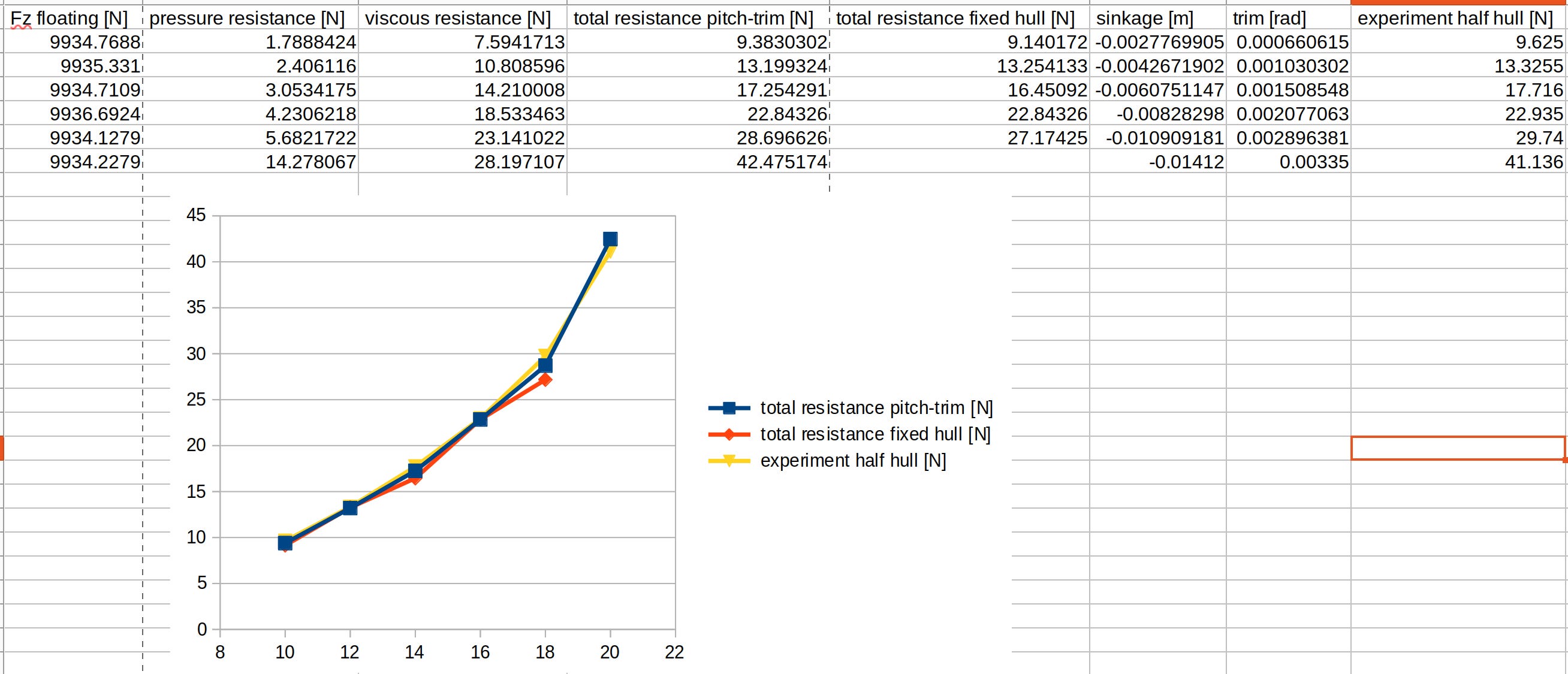
Lesson 2: steady resistance of ship hulls. This is the work-horse of naval hydro CFD. We seek to optimise hull resistance in calm seas. Complications, such as free sinkage and trim will follow. This looks like a run-of-the-mill free surface CFD problem, but it carries a number of challenges. I will mention hydro-structure coupling, ventilation and wet stern effects, leaving the details for a separate post.
Lesson 3: wave modelling. Ocean is never a calm environment: simulating ship resistance on perfectly calm seas is only of limited value. Simulation should concentrate on the actual operating environment, which involves incoming waves, of varying height, encounter frequency and direction. Wave modelling has been done for decades using potential flow formulation with remarkable accuracy and results. Matching this to CFD has proven quite a challenge.
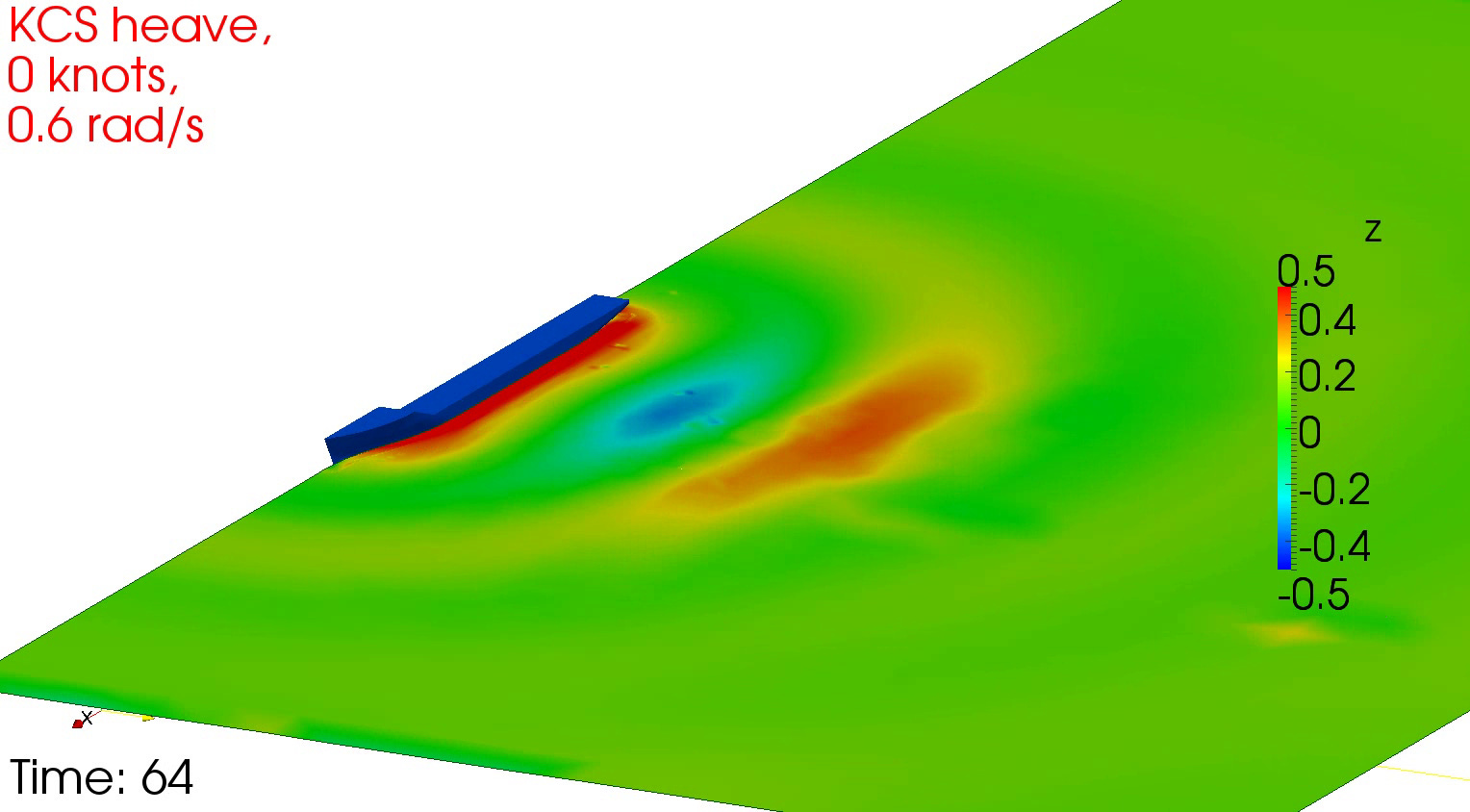
Lesson 4: floating objects. Having a ship floating in water - as opposed to fixed sinkage and trim - brings problems of hydro-structural coupling. In the language of naval architects, this is referred to as the “added mass problem” - a misnomer if I’ve ever seen one. Briefly, your entire ship hull is treated as a solid body exposed to fluid forces. Motion of the body changes the shape of the fluid domain, creating a 2-way coupled system with added mass coupling issues. Resolving this coupling is essential and with bad CFD leads to simulation blow-up.
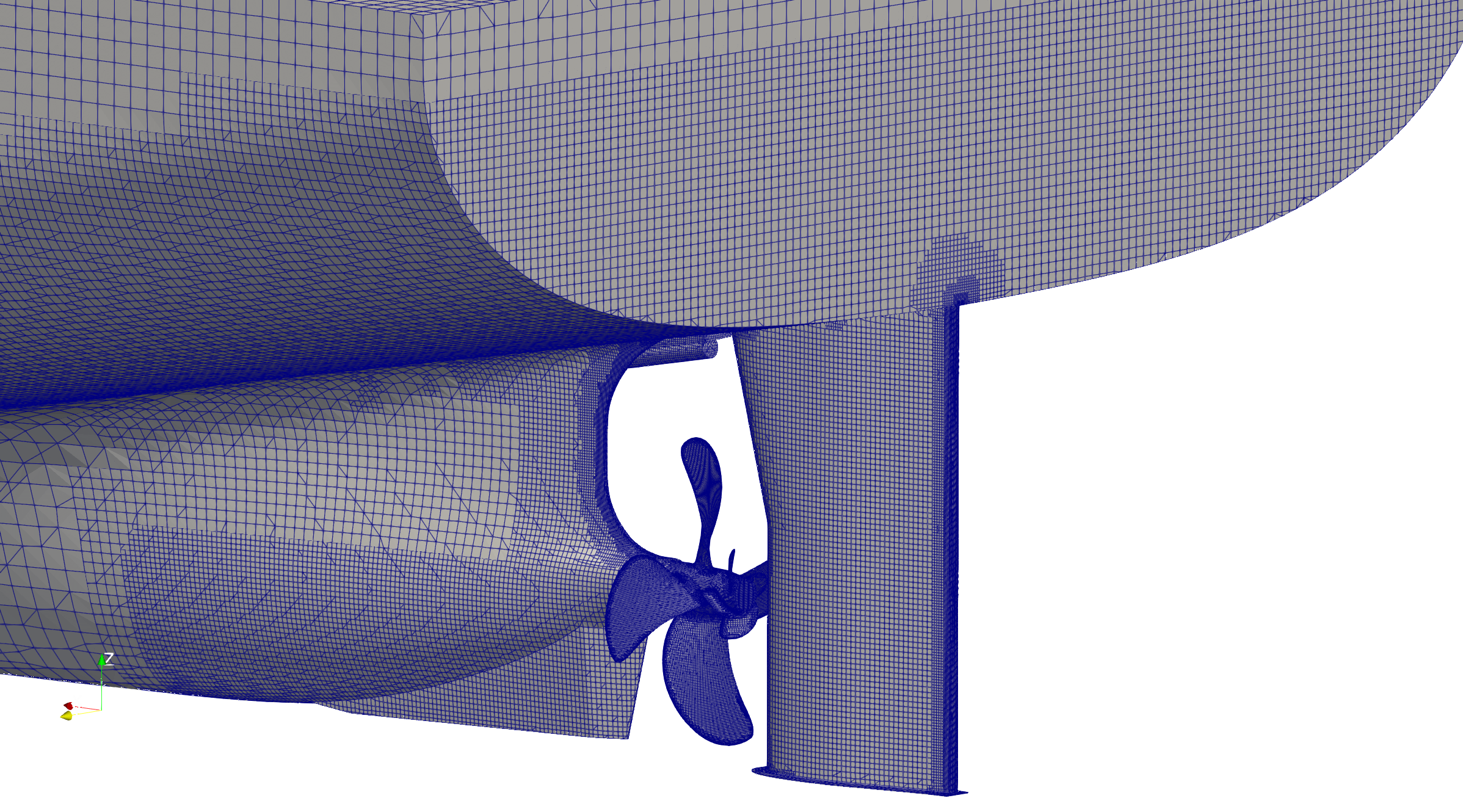
Lesson 5: self-propulsion. Until very recently, naval hydro CFD mainly addressed CFD simulations of towing tank experiments. From one perspective, this is clear: a wave tank is our only source of good experimental data for comparison, under strictly controlled conditions. From the other, using CFD to simulate the model goes against everything I stand for. Scaling issues remain, Reynolds number is very wrong indeed, and there is a wealth of phenomena that cannot be simulated at model scale. To address a ship CFD at full scale, it is necessary to model its propulsor: sometimes this is easier said that done.
Starting with this as a basic set, we can build up more complex cases. For example, sea-keeping involves ship behaviour when sailing in regular waves, which can be in constrained or free-sailing conditions; it may involve controlling the propeller rpm to achieve given speed or rudder motion to preserve the direction. Full-scale models carry their own challenges - and not only in CFD.
This will give you a picture of the challenge ahead. In future episodes we will address them one by one - and much more. Where possible I will give you links to relevant papers and explain my thinking behind various improvements in CFD methodology and simulation practice.
All the results in this blog are produces using the NavPak and Naval Hydro Pack by Wikki. Contact me for further details at https://www.wikki.co.uk , by direct message or by E-mail.
For more information on Wikki’s naval hydrodynamics CFD products, please see our web page
and
Excellent overview of the challenges we face. I'm especially excited about using viscous CFD to supplement potential flow modeling, which works well for many cases as you mention.