
In the previous post, I spoke about wave flume modelling. This time, we shall jump into the deep waters of 6-Degrees-of-Freedom (6-DoF) floating bodies in free surface flow. Starting with the basics of moving deforming mesh, I will describe the coupling problem and consequence. In the spirit of “The Need For Speed” post, we will then consider how to make this faster and more robust.
Consider a simulation of a ship in waves. The solution is sought in terms of a transfer function, showing hull forces and ship motion as a function of incoming wave conditions. Figures below show the total resistance (force) and pitch (motion) transfer function for the 5 head wave heights for the KCS Hull, as prescribed by the 2015 Tokyo Workshop, Case 2.10.
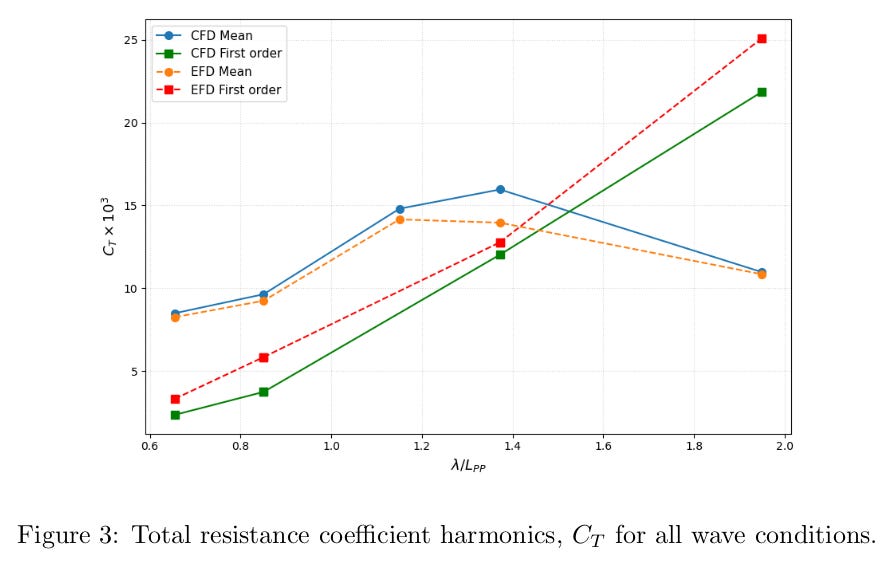
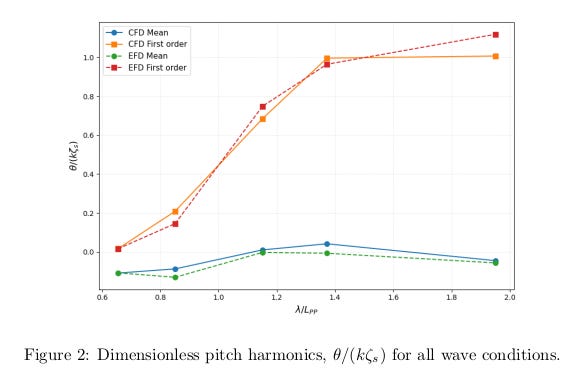
Simulation of a floating structure involves a 6-DoF motion of the hull, under the forces evaluated from a CFD simulation. CFD provides forces, 6-DoF calculates motion and the domain shape for CFD is changed accordingly. The two cannot be fully coupled because of the sequential nature of the solution.
While this - the simplest of solid-fluid interaction probles - seems simple, there is a sting in the tail: added mass effect. Added mass is the ultimate way of misleading the audience: there is no mass and it is not added. However, consequences of the added mass problem are substantial and may prove to be exceedingly costly.
To describe the added mass problem, consider motion of a body submerged in water due to an imposed force. In order to move the body, we not only accellerate its mass, but also need to move the surrounding fluid “out of the way”. This is conceptually easy to understand, but determining the mass that needs to be moved is not easy. Instead, added mass is described as the effect of the reactive force that is “in phase with acceleration”: it is not a real mass, but simply a consequence of a coupling problem between a moving (6-DoF) body and the surrounding fluid.
A conventional way of dealing with the added mass problem is under-relaxation. The sequence of solution flips between the CFD solution (providing the forces) and 6-DoF solution (providing the motion), until the two agree on a converged force and body position. Tricks like Aitken relaxation are regularly used, but the number of hydro-mechanical coupling iterations may be excessive.
Consider a problem where a wave impacts a rigid wall, figure below. (Incidentally, this simulation accounts for the effects of air compressibility during impact, but more on that some other time).

Instead of assuming that the wall is rigid, consider the case where a wave impacts a wall nominally supported by springs. A large impact force will make the wall “move away” from its starting position, with profound effect. Additional volume is freed by wall retraction which, due to continuity, reduces the surface pressure spike and thus the transmitted force.
Can this be modelled in the existing CFD + 6-DoF framework? With some effort. The paper by Gatin [EnhancedCoupling] shows how to do it. Briefly, the wall boundary condition is no longer a zero-flux condition (corresponding to an impermeable wall). Instead, once the force and moment on the 6-DoF body is established, it is possible to calculate the wall acceleration by assuming the motion response.

Instead of assuming that the wall is rigid, consider the case where a wave impacts a wall nominally supported by springs. A large impact force will make the wall “move away” from its starting position, with profound effect. Additional volume is freed by wall retraction which, due to continuity, reduces the surface pressure spike and thus the transmitted force.
Can this be modelled in the existing CFD + 6-DoF framework? With some effort. The paper by Gatin [EnhancedCoupling] shows how to do it. Briefly, the wall boundary condition is no longer a zero-flux condition (corresponding to an impermeable wall). Instead, once the force and moment on the 6-DoF body is established, it is possible to calculate the wall acceleration by assuming the motion response.
The change in body velocity for each face is built into the pressure equation, via the non-zero wall normal flux caused by the 6-DoF motion response. The change of the body velocity is inserted in the pressure equation by updating the source term b for cells adjacent to the body boundary.
This correction can be performed at each pressure solution in the PISO-SIMPLE pressure-velocity coupling algorithm, rather than only at convergence. The approach actually introduces an inconsistency to the hull wall velocity, as the velocity field in the momentum equation is not updated. Instead, it is recognised that the coupling is actually a pressure-flux coupling and subsequent 6-DoF motion (and the mesh motion flux) will make sure that the NET flux through the moving wall is zero. The wall flux caused by motion response is simply a way that allows the pressure solver not to over-estimate the impact force: it models the fact that the wall is supported elastically instead of remaining rigid upon impact.
External iterations will tidy up the remaining inconsistency. First, pressure velocity coupling in the SIMPLE loop will update the convection-diffusion terms in the momentum equation, whereas external hydro-mechanical coupling tidies up any errors in the estimate of 6-DoF motion response to the force.
The hydro-mechanical coupling trick is here to reduce the over-estimate of the pressure impact force by CFD. In practical implementations, the 6-DOF solver of the body is “queried” for motion response under a given force-moment impact, but without executing actual mesh motion - or indeed updating the wall boundary condition.
The improvement in performance is profound. A normal sea-keeping simulation will use 100-200 time-steps per wave encounter period, execute about 50 CFD-to-6-DoF coupling iterations and for each of those use 5-10 SIMPLE pressure-velocity coupling iterations.
In the NavPak setup, the number of time-steps per wave encounter period is approximately the same. The 6-DOF solver is queried in every PISO corrector of the PIMPLE (= SIMPLE-PISO) CFD convergence loop, using, say 6 outer correctors and 4 PISO correctors per outer corrector. The 6-DoF solver is therefore queried 24 times per time-step, but mesh deformation and pressure-velocity coupling is updated only 6 times. If the flow is not too violent (no regular slamming loads), we can reduce the number of outer correctors to 4 without loss of accuracy or stability. Taking the balance, the NavPak solver executes the coupling 6 times per time-step, compared to 50 such iterations necessary without the hydro-mechanical coupling trick. It is easy to be faster than competition if you are doing 8 times less work.
The hydro-mechanical coupling trick improves the overall stability of the simulation. To demonstrate this, in figures below one can see multiple 6-DOF motion updates executed within a single time-step.
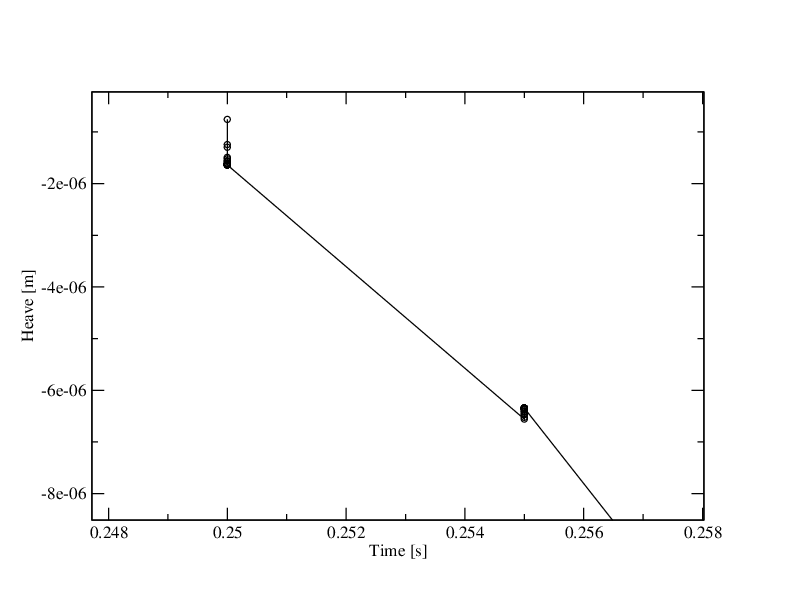
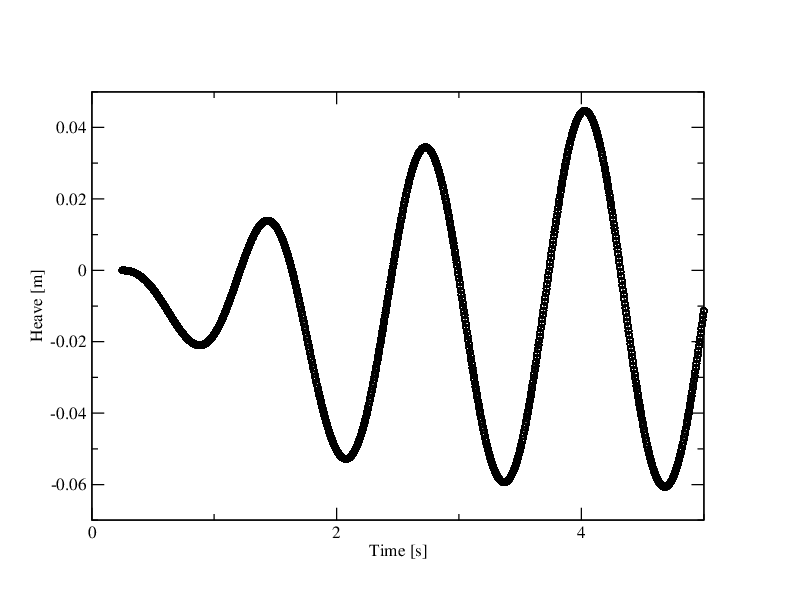
On start-up, when the hull just starts to move, the convergence sequence is actually visible. Once the motion is established, the minute differences in 6-DoF solution within a single time-step are so small they cannot be seen. The coupling problem is still there, but the enhanced coupling framework of Gatin is so powerful (predictive) that the pressure force spike becomes irrelevant.
The net effect of all this is a very, very fast solver! Aitken relaxation is still there, multiple motion updates within the time-step are still executed but the elastic wall impact consideration takes the sting out of coupling.
It remains to determine the mechanism of mesh deformation which complies with the 6-DoF hull motion and preserves the mesh quality and alignment with the free surface - yet another topic for a future post.
In steady-state, we will use one additional trick: critical damping. More on that in a future blog.
All the results in this blog are produced using the NavPak and Naval Hydro Pack by Wikki. Contact me for further details at https://www.wikki.co.uk , by direct message or by E-mail.
For more information on Wikki’s naval hydrodynamics CFD products, please see our web page
and
https://wikki.co.uk/naval-hydrodynamics/
Happy reading,
Hrvoje